
What Did My Neighbour’s House Sell For? (Ireland)
Find out what any house in Dublin sold for — free. 3 methods to check real sale prices from the Property Price Register, with area trends and price context.
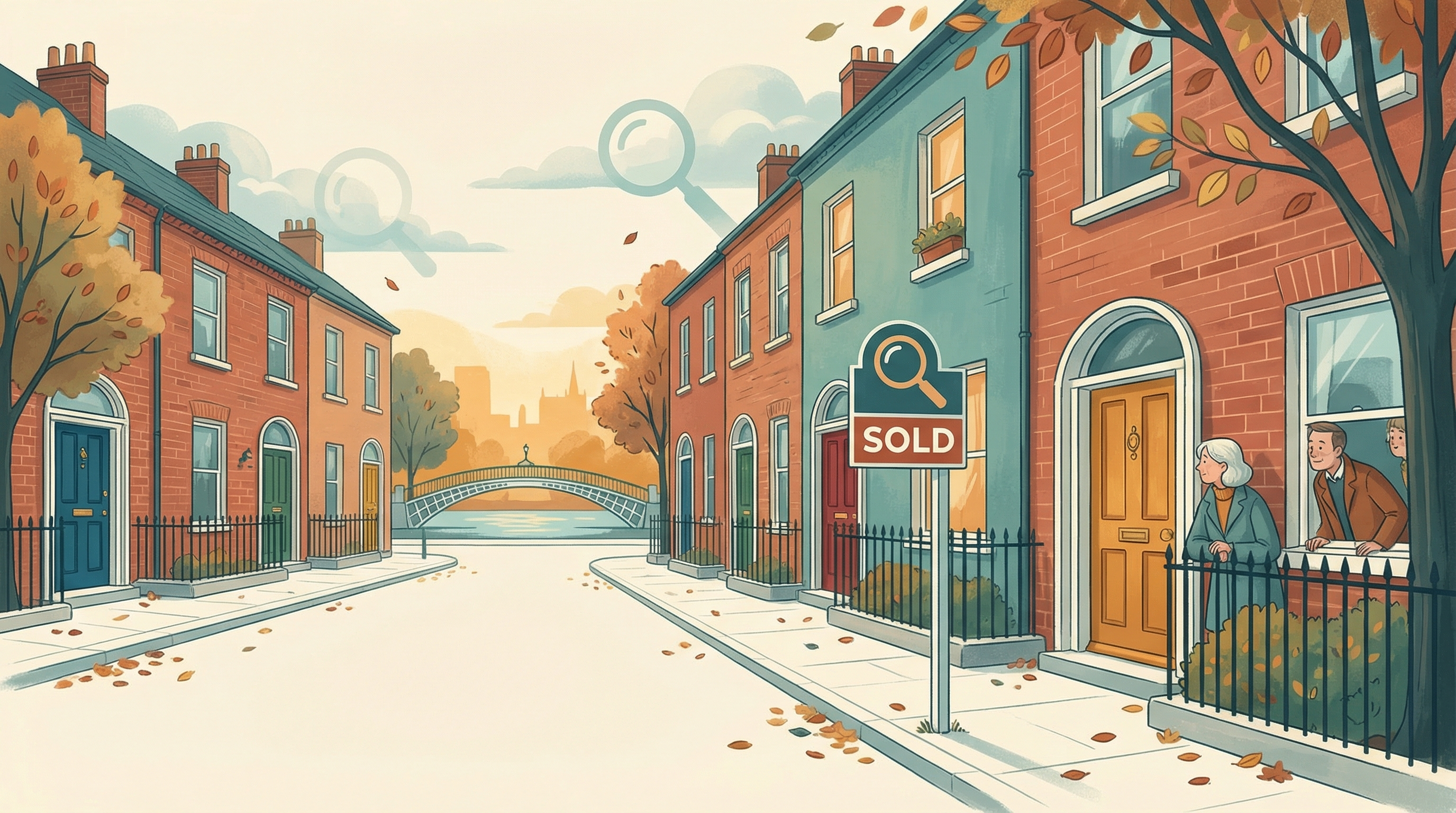
We’ve all done it. The sold sign goes up next door, the removals van pulls away, and the first thing you do is wonder: what did they get for it?
Good news — in Ireland, every residential property sale price is public record. You don’t need to know someone who knows someone. You don’t need to ask the estate agent and hope they’re not rounding up. The data is there, published by the government, free to access.
Here’s how to find it, what it actually tells you, and where the data falls short.
Are Irish Property Sale Prices Public?
Since 2010, the Property Services Regulatory Authority (PSRA) has maintained the Property Price Register (PPR) — a public database of every residential property sale in Ireland. It’s a legal requirement: every sale gets reported via stamp duty returns to Revenue, and the data is published online for anyone to search.
This isn’t some loophole or data scraping. It’s by design. The PPR was introduced after the property crash to bring transparency to a market that badly needed it. When nobody could tell what anything was actually worth, making sale prices public was the obvious fix.
Every entry includes the date of sale, the price paid, the address, and whether it was a new or second-hand property. That’s it. No photos, no floor plans, no BER rating, no context about the south-facing garden or converted attic. Just the raw transaction.
That raw transaction data is more useful than most people realise.
Method 1: The Official Property Price Register
The PPR at propertypriceregister.ie is the primary source. Every sale price in Ireland flows from here.
How to search:
- Go to propertypriceregister.ie
- Select the county and enter the area or address
- Set your date range and hit search
You’ll get a list of sales with addresses, dates, and prices. Simple enough in theory.
In practice, it’s clunky. The search requires near-exact address matching. If the register has “12 Oak Drive” and you type “12 Oak Dr”, you might get nothing. There’s no Eircode search. No map view. No way to browse by neighbourhood or see what’s happening on a particular street without knowing the exact address format the register uses.
A few tips that help:
- Use less, not more. Search “Oak” rather than “12 Oak Drive, Raheny” — cast a wider net and scan the results
- Try spelling variations. “Kilbarrack” vs “Kilbarack”, “Saint” vs “St.” — the register isn’t forgiving
- Leave the address field mostly empty and filter by area instead — you’ll get more results to browse through
Power user tip: the PSRA also offers a downloadable CSV of the entire register. If you want to analyse prices across a whole area or compare streets, dropping the CSV into a spreadsheet gives you far more flexibility than the web search.
It works. But it takes patience.
Method 2: Property Portals (Daft.ie, MyHome.ie)
Daft.ie and MyHome.ie both have sold property sections that pull from the same PPR data.
The advantage: you can sometimes match a sold price back to the original listing. That means you get the asking price AND the sale price, plus photos, room counts, and the estate agent’s description. That’s genuinely useful context that the PPR alone doesn’t give you.
The limitation: these portals focus on current listings. Their sold property search is secondary — it exists, but it’s not their core product. You get the raw sale data without any area context, trend analysis, or neighbourhood comparison.
They’re worth checking, especially if the property was listed recently and you want to see the original listing alongside the final price.
Method 3: Dublish — See the Full Picture
This is where the lookup stops being a one-off data point and starts being actually useful.
Dublish indexes over 200,000 Dublin properties with sale history from the Property Price Register, combined with BER energy ratings from SEAI and rental market data from the RTB. Instead of just telling you what a house sold for, it shows you what that price means.
Search any Dublin address and you’ll see:
- Every recorded sale — full PPR history for that property, not just the most recent
- Area median prices — is €450,000 high or low for that street? Now you know
- Price trends — is the area getting more expensive or levelling off?
- BER rating — the energy efficiency of the property, where available
- Rental data — what comparable properties in the area rent for
Say your neighbour’s house in Raheny sold for €520,000. On the PPR, that’s just a number. On Dublish, you can see that the Dublin 5 median is €472,000, the area trend over the last decade, and whether the property has sold before. That context transforms a data point into actual intelligence.
Search any Dublin address on Dublish →
What the Sale Price Actually Tells You (And What It Doesn’t)
The PPR gives you the price that was declared to Revenue for stamp duty purposes. For the vast majority of sales, this is the actual price the buyer paid. It’s reliable data.
But there are important caveats.
The double asterisk (**)
Some PPR entries show the price with **. This means the stated price may not reflect full market value. Common reasons:
- Family transfers — a parent selling to a child at below market rate
- Partial interests — only a share of the property was sold
- Multi-unit deals — the price covers more than one property in a bundle
These entries are real transactions, but they shouldn’t be used to gauge what a property is “worth” on the open market.
New builds and VAT
For new properties, the PPR price includes VAT (13.5% for residential). This is the price the buyer actually paid, so it’s accurate for comparison purposes. But if you’re trying to figure out the developer’s base price, you’ll need to back out the VAT.
What the PPR doesn’t show
The PPR deliberately doesn’t include:
- Floor area or number of bedrooms — a 2-bed apartment and a 5-bed detached house on the same road look identical in the data
- Property condition — a fully renovated home and a fixer-upper both show as a sale price with no context
- Whether it was cash or mortgage — relevant for understanding market dynamics
- The asking price — you only see what it sold for, not what it was listed at (and the gap can be significant)
This is exactly why raw PPR data needs context. A sale price without knowing the property size, condition, or area trends is only half the story.
The timing gap
Sales typically appear on the PPR within two to four months of closing. The solicitor files the stamp duty return with Revenue, and Revenue passes the data to the PSRA for publication. If a house sold last month and you can’t find it yet, give it time.
Why People Check House Sale Prices (It’s Not Just Curiosity)
Sure, nosiness is a perfectly valid reason. We all do it. But there are genuinely practical uses for sale price data that go well beyond idle curiosity:
Thinking of selling? Knowing what comparable properties on your street actually sold for — not what they were listed at, but what buyers actually paid — is the single best way to set realistic expectations. Estate agents have an incentive to price high to win the listing, then gradually reduce. The PPR gives you the unvarnished facts, and you can spot patterns yourself: did properties on your road consistently sell above or below asking? Are prices climbing or flattening?
About to buy? Before making an offer, check what similar properties in the area have actually sold for recently. The asking price is a starting position, not a fact. A house listed at €475,000 might have sold for €440,000 — or €510,000. Only the PPR tells you which. That information shapes your bidding strategy and prevents overpaying.
Mortgage or valuation? Banks and independent valuers use PPR data as part of their property assessment. When your valuer checks comparable sales, they’re looking at the same register you can access. Having the data in advance means you’re not walking in blind, and you can challenge a valuation if the comparables don’t match what you’ve found.
Inheritance or probate? Establishing the market value of a property for Capital Acquisitions Tax (CAT) purposes requires evidence. Recent comparable sales from the PPR are exactly that evidence — and Revenue accepts them as valid market indicators.
Neighbourhood investment? Whether you’re already on the street or considering buying in, understanding whether prices are trending up, stable, or declining over the last 5-10 years is fundamental. One sale is an anecdote. A decade of sales data is a trend. Area-level analysis turns property watching from guesswork into informed decision-making.
Your Questions Answered
Is the Property Price Register free?
Yes. The PPR at propertypriceregister.ie is completely free to search. There’s no registration, no paywall, no limit on searches. It’s a public service funded by the PSRA.
How long after a house sale does it appear on the register?
Most sales appear within two to four months of completion. The delay comes from the stamp duty filing process — the solicitor submits the return to Revenue, which then passes the data to the PSRA. Some sales can take longer, particularly if there are delays in the legal process.
Can I search the Property Price Register by Eircode?
Not on the official PPR — it doesn’t support Eircode lookup. You need to search by county, area, and address text. Third-party tools like Daft.ie support more flexible search options, and Dublish lets you search Dublin properties by address, area, or Eircode.
What does ** mean on the Property Price Register?
A double asterisk (**) indicates the recorded price may not reflect the full open market value. This typically applies to transactions between related parties (family transfers), sales of partial interests in a property, or multi-property deals where the total price was split across several entries.
What’s the difference between asking price and sale price?
The asking price is what the seller (or their agent) lists the property for on Daft.ie or MyHome.ie. The sale price — recorded on the PPR — is what the buyer actually paid. These can differ significantly. In a competitive market, properties often sell above asking price. In a slower market, below.
Can a sale be removed from the Property Price Register?
No. Once a sale is recorded on the PPR, it stays there permanently. The register was designed for transparency, and there’s no mechanism for individuals to request removal of their transaction data.
Are property sale prices public information in Ireland?
Yes. Every residential property sale in Ireland since January 2010 has been recorded on the Property Price Register, maintained by the Property Services Regulatory Authority (PSRA). The data is derived from stamp duty returns filed with Revenue and is published online for free public access.
Does the Property Price Register include rental prices?
No. The PPR only records property sales, not rentals. Rental data is held separately by the Residential Tenancies Board (RTB) in their rent register. Some property intelligence tools combine both data sources to give a fuller picture of an area’s property market.
How to Look Up a House Sale Price in 30 Seconds
If you just want to know what your neighbour’s house sold for, here’s the fastest route:
- Find the Eircode — eircode.ie if you don’t have it
- Search on Dublish — dublish.ie for the price with area context, or propertypriceregister.ie for the raw data
- Check area trends — see if the price is typical for the neighbourhood, or an outlier
It takes about 30 seconds. And once you start, you’ll probably end up checking every house on the road. Don’t say we didn’t warn you.
Explore Dublin property prices — search 200,000+ properties free on Dublish.