
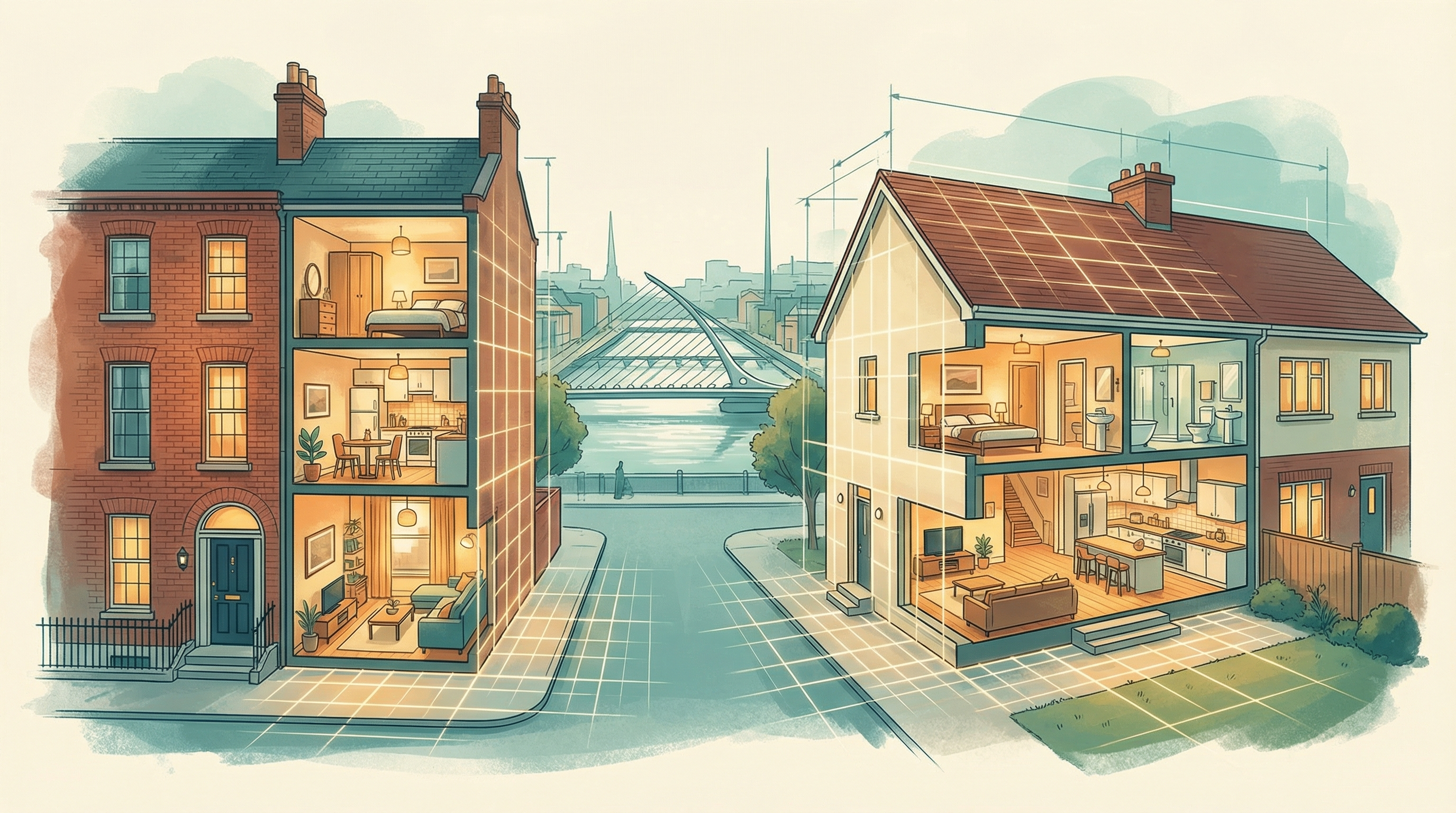
Dublin Price Per Square Metre by Area (2026 Data)
We combined PPR sale prices with BER floor area data to calculate €/m² for every Dublin district. From €3,744 to €9,473 per square metre.
Dublin 6 costs €9,473 per square metre. Dublin 17 costs €3,744. That’s a 2.5x difference — for the same unit of living space.
Everyone talks about Dublin house prices. Median prices, asking prices, what-my-neighbour-got prices. But median prices are almost useless for comparison. A €500,000 house in Ballsbridge might be a 55m² apartment. A €500,000 house in Donaghmede is probably a 110m² semi-detached with a garden. Same price, completely different value.
Price per square metre strips away that noise. It tells you what you’re actually paying for: space to live in. And in Dublin, it varies wildly depending on where you buy.
We built this analysis by combining two public datasets that nobody else in Ireland is cross-referencing at scale. Property Price Register (PPR) sale prices meet BER certificate floor area data from SEAI. The result is a district-by-district breakdown of what Dublin property actually costs per square metre.
How We Calculated Dublin’s Price Per Square Metre
Let’s be upfront about methodology, because the numbers are only useful if you trust how they were generated.
The data sources:
- Property Price Register (PPR): Every residential property sale in Dublin since 2010, published by the PSRA. This gives us real transaction prices — what buyers actually paid, not asking prices.
- BER certificates (SEAI): Energy ratings for Irish properties, which include the floor area in square metres as a required field. We have BER data for over 300,000 Dublin properties.
The calculation:
For each Dublin postal district, we took the median sale price from the last 36 months (March 2023 – March 2026) and divided it by the median BER floor area. Simple division. This gives a representative €/m² figure for each district that reflects current market conditions with a large enough sample to be reliable.
Why 36 months? A single year’s data can be skewed by a handful of outlier sales, especially in smaller districts. Three years gives robust sample sizes — every district in our table has at least 390 sales — while still reflecting the current market rather than post-crash prices from 2012.
Why medians, not averages? Because averages get wrecked by outliers. One €15 million mansion in Ballsbridge would pull an average up dramatically. Medians tell you what the typical property costs per square metre, which is what matters if you’re buying.
What This Doesn’t Capture
Honesty time. This methodology has real limitations:
- Not every property has a BER. Older homes that haven’t been sold or rented recently may not have a BER certificate on file. Coverage varies by area and property age.
- We’re using district medians, not per-property matching. The ideal calculation would match each sale to its specific BER floor area. We’re working on that. For now, we’re comparing the median sale price against the median floor area for the district, which gives a solid representative figure.
- Floor area in BER means different things. BER floor area is the “useful floor area” — heated internal space. It excludes garages, sheds, and most attic space. This is consistent across all properties, which actually makes it good for comparison.
- New builds vs older stock. Districts with lots of new apartment developments (Dublin 1, Dublin 8) will have smaller median floor areas than established suburban areas. This is reflected in the data and partly explains why some inner-city districts have high €/m² figures.
With those caveats on the table, let’s look at the numbers.
Dublin Price Per Square Metre: The Full District Breakdown
Here’s every Dublin district ranked by price per square metre, based on the median sale price over the last 36 months.
| District | Median Price (36mo) | Median Floor Area | €/m² | Sales (36mo) |
|---|---|---|---|---|
| Dublin 6 | €691,500 | 73 m² | €9,473 | 1,530 |
| Dublin 4 | €645,920 | 78 m² | €8,281 | 2,535 |
| Dublin 2 | €454,250 | 60 m² | €7,571 | 732 |
| Dublin 14 | €665,000 | 106 m² | €6,274 | 1,742 |
| Dublin 18 | €557,000 | 89 m² | €6,258 | 2,785 |
| Dublin 7 | €425,000 | 68 m² | €6,250 | 1,965 |
| Dún Laoghaire–Rathdown | €656,387 | 107 m² | €6,134 | 4,874 |
| Dublin 8 | €373,000 | 61 m² | €6,115 | 2,128 |
| Dublin 6W | €663,000 | 110 m² | €6,027 | 892 |
| Dublin 3 | €475,000 | 80 m² | €5,938 | 1,726 |
| Dublin 1 | €328,000 | 57 m² | €5,754 | 1,083 |
| Dublin 16 | €600,000 | 110 m² | €5,455 | 1,567 |
| Dublin 12 | €421,500 | 81 m² | €5,204 | 1,901 |
| Dublin 5 | €471,549 | 94 m² | €5,016 | 1,566 |
| Dublin 13 | €470,500 | 94 m² | €5,005 | 1,958 |
| Dublin 9 | €450,000 | 90 m² | €5,000 | 2,050 |
| Dublin 20 | €400,500 | 87 m² | €4,603 | 392 |
| Dublin 22 | €345,500 | 83 m² | €4,163 | 1,548 |
| Dublin 24 | €345,000 | 85 m² | €4,059 | 2,754 |
| Dublin 15 | €385,000 | 96 m² | €4,010 | 4,062 |
| South Dublin | €419,910 | 105 m² | €3,999 | 3,267 |
| Fingal | €418,502 | 105 m² | €3,986 | 6,699 |
| Dublin 10 | €300,000 | 78 m² | €3,846 | 488 |
| Dublin 11 | €312,250 | 82 m² | €3,808 | 1,728 |
| Dublin 17 | €307,000 | 82 m² | €3,744 | 437 |
The range: From €9,473/m² in Dublin 6 to €3,744/m² in Dublin 17. The most expensive district costs 2.5 times more per square metre than the cheapest.
Why Some Districts Cost More Per Square Metre
The ranking above tells a story that median prices alone don’t capture.
The “small and expensive” effect
Dublin 1, Dublin 2, and Dublin 8 punch above their weight on €/m² despite having relatively low median prices. Why? Because they’re dominated by apartments. The median floor area in Dublin 1 is just 57m². In Dublin 2, it’s 60m². You’re buying less space, so the per-metre cost is high even when the headline price looks moderate.
A €328,000 apartment in Dublin 1 sounds more affordable than a €471,549 house in Dublin 5. But per square metre, Dublin 1 costs €5,754/m² versus Dublin 5’s €5,016/m². You’re paying 15% more per unit of space in Dublin 1.
The “big and expensive” effect
Dublin 6 tops the chart at €9,473/m². The median floor area is 73m² — reflecting a mix of Victorian terraces, conversions, and newer apartment schemes — but prices are high across the board. Rathmines, Ranelagh, and Rathgar are all firmly premium neighbourhoods with deep buyer demand.
Dublin 4 follows closely at €8,281/m². In neighbourhoods like Ballsbridge and Sandymount, you’re comfortably into the upper end of the market. The median floor area here is 78m², reflecting a mix of period homes and modern apartments.
The suburban value play
The bottom of the table is where you get the most space for your money. Dublin 17 at €3,744/m² and Fingal at €3,986/m² offer roughly 2.4–2.5 times more space per euro than Dublin 6.
Dublin 15 stands out as a particularly interesting case. At €4,010/m² with a median floor area of 96m², it’s one of the most space-efficient places to buy in Dublin. The area has over 4,000 sales in the last three years — the third largest sample after Fingal and Dún Laoghaire–Rathdown — so the data is robust.
Dublin Price Per Square Metre: Neighbourhood Deep Dive
District-level numbers hide huge variation. Here’s what €/m² looks like within some of Dublin’s most popular areas, using all-time median sale prices (since 2010) and district-level BER floor areas.
Dublin 4: Where Every Square Metre Is Gold
| Neighbourhood | All-Time Median | Est. €/m² | Sales |
|---|---|---|---|
| Sandymount | €690,000 | ~€8,846 | 1,430 |
| Ballsbridge | €688,000 | ~€8,821 | 2,016 |
| Donnybrook | €625,750 | ~€8,022 | 1,691 |
| Merrion | €622,500 | ~€7,981 | 416 |
| Irishtown | €480,000 | ~€6,154 | 348 |
| Booterstown | €462,500 | ~€5,929 | 514 |
| Ringsend | €400,000 | ~€5,128 | 735 |
The difference within Dublin 4 alone is significant. Sandymount and Ballsbridge at around €8,800/m² are well above Ringsend at €5,128/m². Same postal district, very different market. Ringsend is arguably one of the best value pockets in south Dublin for this reason.
Dublin 5: Northside Family Territory
| Neighbourhood | All-Time Median | Est. €/m² | Sales |
|---|---|---|---|
| Raheny – Foxfield | €560,000 | ~€5,957 | 194 |
| Raheny | €490,000 | ~€5,213 | 655 |
| Clontarf | €432,000 | ~€4,596 | 1,310 |
| Raheny – Greendale | €429,000 | ~€4,564 | 236 |
| Donaghmede | €387,000 | ~€4,117 | 1,357 |
| Coolock | €362,500 | ~€3,856 | 146 |
Dublin 5 ranges from about €6,000/m² in the premium parts of Raheny down to around €3,850/m² in Coolock. Donaghmede is interesting: at approximately €4,100/m² with 1,357 sales in the dataset, it’s a big, consistent market. Good data confidence.
Dublin 3: Clontarf Premium
| Neighbourhood | All-Time Median | Est. €/m² | Sales |
|---|---|---|---|
| Clontarf | €528,567 | ~€6,607 | 4,562 |
| Marino | €407,750 | ~€5,097 | 372 |
| Drumcondra | €372,250 | ~€4,653 | 921 |
| North Wall | €335,000 | ~€4,188 | 714 |
| Fairview | €326,500 | ~€4,081 | 244 |
| North Strand | €287,500 | ~€3,594 | 230 |
| East Wall | €235,000 | ~€2,938 | 352 |
Clontarf is the anchor of Dublin 3, with 4,562 sales and an estimated €6,607/m². That’s a huge dataset — this isn’t a handful of lucky sales pushing the number up. Contrast that with East Wall at €2,938/m²: less than half the per-metre cost, a short walk away.
Dún Laoghaire–Rathdown: The Prestige Belt
| Neighbourhood | All-Time Median | Est. €/m² | Sales |
|---|---|---|---|
| Dalkey Commons | €986,000 | ~€9,215 | 226 |
| Bullock | €840,000 | ~€7,850 | 577 |
| Mount Merrion | €815,000 | ~€7,617 | 402 |
| Foxrock | €814,977 | ~€7,617 | 107 |
| Dalkey | €705,000 | ~€6,589 | 852 |
| Dún Laoghaire | €500,000 | ~€4,673 | 2,714 |
| Sandyford | €406,000 | ~€3,794 | 593 |
DLR contains some of Dublin’s most varied €/m² figures. Dalkey Commons at €9,215/m² reflects concentrated high-value sales, while Sandyford at €3,794/m² is driven by its large apartment stock. If you want the Dún Laoghaire–Rathdown postcode without the premium, that’s where to look.
What Does Dublin’s Price Per Square Metre Tell Buyers?
1. Headline prices are misleading
A €373,000 property in Dublin 8 might look similar to a €385,000 property in Dublin 15. But Dublin 8’s median floor area is just 61m² — Dublin 15’s is 96m². Per square metre, Dublin 8 costs €6,115 versus Dublin 15’s €4,010. That’s over 50% more per unit of space, despite the headline prices being almost the same. Price per square metre reveals the true cost of the space you’re buying.
2. Inner-city apartments are expensive per metre
Dublin 1, 2, 7, and 8 all have high €/m² figures despite relatively low median sale prices. This is the apartment effect. Compact units in central locations command a premium per unit of space, even when the total price looks affordable.
If you’re comparing a city-centre apartment against a suburban house, price per square metre is the only fair comparison. It strips away the size variable.
3. The suburbs offer more space per euro
Fingal, South Dublin, Dublin 10, Dublin 11, and Dublin 17 all come in under €4,000/m². These areas have larger houses (median floor areas of 78–105m²) and lower prices. For families who need space, the value proposition is clear.
4. Neighbourhood matters more than district
Dublin 4 ranges from about €5,100/m² (Ringsend) to €8,850/m² (Sandymount). That variation within a single district is bigger than the difference between many districts. Always drill down to neighbourhood level before making price comparisons.
5. High €/m² can mean strong investment
Areas with high price per square metre tend to hold value better in downturns and recover faster. Dublin 4, Dublin 6, and DLR have all shown this pattern through multiple market cycles. You’re paying more per metre, but you’re buying into a more resilient market.
How Dublin Compares: European Context
For context, here’s how Dublin’s price per square metre stacks up against other European cities (approximate 2025/2026 figures):
| City | Approx. €/m² (City Centre) |
|---|---|
| London | €15,000–€20,000 |
| Paris | €10,000–€14,000 |
| Dublin (D6) | €9,473 |
| Munich | €9,000–€12,000 |
| Amsterdam | €8,000–€11,000 |
| Dublin (D4) | €8,281 |
| Dublin (city avg) | €5,000–€6,000 |
| Barcelona | €5,000–€7,000 |
| Lisbon | €5,000–€7,000 |
Dublin’s premium districts are in the same bracket as Munich and Amsterdam. The city-wide average is more in line with Barcelona or Lisbon. Whether that represents good or bad value depends entirely on what you’re comparing it to — and what you need from your location.
Price Per Square Metre: Apartments vs Houses
One thing these numbers don’t separate (yet) is property type. And it matters.
Apartments and houses have fundamentally different economics per square metre. A 55m² apartment in a modern block comes with shared facilities, a management company, and typically higher €/m² figures. A 120m² semi-detached house includes a garden, a driveway, and potential to extend — none of which is captured in the BER floor area.
Here’s a rough guide based on what we see in the data:
Inner city (Dublin 1, 2, 7, 8): Dominated by apartments. The high €/m² figures here largely reflect apartment pricing. If you could isolate houses in these districts, the €/m² would be even higher — but there are so few houses that the data wouldn’t be meaningful.
South Dublin premium (Dublin 4, 6, 6W, 14): A mix of period houses, modern apartments, and conversions. The €/m² here reflects genuine demand for the location regardless of property type. Houses typically command a premium over apartments per square metre because of the land value.
Suburban family belts (Dublin 5, 9, 11, 12, 15, 24): Mostly houses. These areas give you the most reliable house-specific €/m² figures since apartments are a smaller proportion of sales.
County areas (Fingal, South Dublin, DLR): Wide variety. DLR ranges from Sandyford apartments at €3,794/m² to Dalkey Commons at over €9,200/m². Fingal is dominated by newer suburban housing estates.
We’re building per-property-type breakdowns as part of our matching pipeline. Stay tuned.
Frequently Asked Questions
What is a good price per square metre in Dublin?
It depends where you’re buying. The Dublin-wide median is roughly €5,000–€5,500/m² based on recent sales. Anything below €4,500/m² represents good value relative to the city average. Below €4,000/m² and you’re in the most affordable bracket — typically outer suburbs and county areas.
Why is Dublin 6 the most expensive per square metre?
Dublin 6 includes Rathmines, Ranelagh, Rathgar, and Harold’s Cross. These are established, high-demand neighbourhoods with excellent amenities and transport links. The mix of Victorian terraces, period conversions, and modern apartments in a compact area drives consistently high prices relative to floor area.
Is price per square metre more useful than median house price?
For comparing areas, yes. Median prices mix apartments, terraces, semis, and detached houses. A €300,000 median could mean cheap big houses or expensive small apartments. Price per square metre normalises for size and gives a fairer comparison of what each area actually costs to live in.
Where is the cheapest price per square metre in Dublin?
Dublin 17 (Belcamp, Priorswood) at €3,744/m², Dublin 11 (Finglas, Glasnevin) at €3,808/m², and Dublin 10 (Ballyfermot, Cherry Orchard) at €3,846/m². These areas offer the most living space per euro spent.
How does Dublin compare to other Irish cities?
Dublin is significantly more expensive per square metre than other Irish cities. Cork, Galway, and Limerick typically range from €2,500–€4,500/m² depending on the neighbourhood. Dublin’s premium districts cost 2–4x more per metre than a typical property in regional cities.
Explore Dublin Property Data
Every number in this article comes from real PPR and BER data, cross-referenced and published on Dublish. You can explore the data yourself:
- Search any Dublin address to see its full sale history, BER rating, and area context
- Browse by district to see median prices, trends, and neighbourhood breakdowns
- Compare areas with real data instead of estate agent opinions
All free. No registration. Just data.
Explore Dublin property prices on Dublish →
Data sources: Property Price Register (PSRA), BER certificates (SEAI). Analysis by Dublish. District-level figures use a 36-month rolling median (March 2023 – March 2026) for robust sample sizes. Neighbourhood figures use all-time medians (since 2010). Floor areas are median BER-certified floor areas per district. Per-property matching is in development — current figures use district-level medians. Last updated: March 2026.